

Last verified November 2026
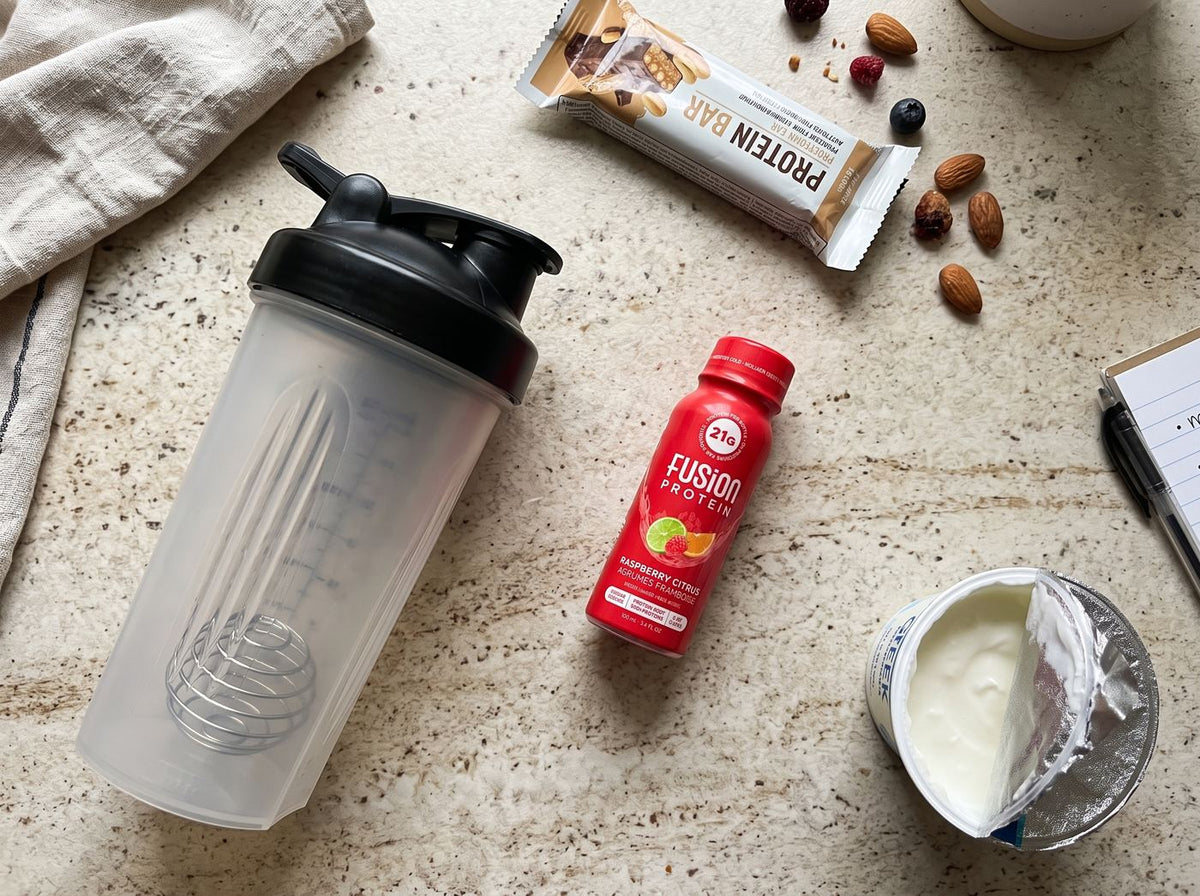
If you have ever chugged a plain protein shake mixed with water at 7:30 a.m., you already know how the story goes: you feel virtuous for about an hour, and by 10:00 a.m. your stomach is growling and you are raiding the kitchen for a muffin.
That happens because a plain protein shake is an ingredient, not a meal. It gives you a great head start on protein, but it has almost no dietary fibre, very few complex carbs, and barely any fat. With nothing to chew and little fibre or fat to slow it down, it does not keep most people full for long, so hunger tends to come back well before lunch.
Sources: Health Canada (fibre); Schoenfeld and Aragon, 2018, JISSN (Schoenfeld serves on the scientific advisory board for Dymatize Nutrition); Mamerow et al., 2014, Journal of Nutrition (tested in 8 healthy adults; authors D. Paddon-Jones and D. K. Layman received speaking fees from the National Cattlemen's Beef Association).
What makes a breakfast keep you full
Staying full from 8:00 a.m. until noon is not just about hitting a magic calorie number. Your stomach and your brain judge a meal in two different ways: physical volume (how much space the food takes up and how long it stays in your stomach) and hormonal signals (how the nutrients enter your bloodstream).
A plain shake gives your stomach very little to work on: no fibre, almost no fat, and nothing to chew. To get three or four hours of steady energy without a mid-morning crash, your breakfast has to bring three things to the table.

Protein
Protein is the undisputed heavy hitter for appetite control. When you eat a solid dose of protein in the morning, it helps dial down your hunger hormones and keeps you feeling satisfied longer than a carb-only breakfast like plain white toast or a pastry.
In a 2013 study by Heather Leidy and colleagues (published in the American Journal of Clinical Nutrition), 20 overweight or obese young women ages 18 to 20 who usually skipped breakfast tried three routines for six days each: a 350-calorie breakfast with 13 grams of protein (normal protein), a 350-calorie breakfast with 35 grams of protein (high protein), or no breakfast at all. Both breakfasts increased fullness compared with skipping, and the 35-gram breakfast increased it more. Only the high-protein breakfast cut evening snacking on high-fat foods compared with skipping (note: this study was funded by the Beef Checkoff program and the Egg Nutrition Center).
Protein sets the foundation, which is why a shake is such a convenient starting point. It just cannot do the whole job alone.
Fibre
If protein is the anchor of a filling breakfast, fibre is the brake pedal. Found in foods like oats, berries, chia seeds, and whole-grain bread, fibre adds bulk to your meal, and some kinds (like the soluble fibre in oats and chia) absorb water and slow down how fast food leaves your stomach.
According to Health Canada, Canadian women need 25 grams of fibre a day and men need 38 grams, yet most of us only get about half that much. Starting your day with a zero-fibre protein shake means you are already playing catch-up by lunch, and you miss an easy chance to get some of it from an apple or a slice of seeded toast.
Carbs and fat
Carbohydrates and dietary fats get a bad reputation in certain diet circles, but they play a practical role at the breakfast table:

Complex carbohydrates
Like rolled oats, fruit, or whole-grain toast, they give your brain and muscles accessible morning fuel. Paired with protein and fibre, they make for steadier energy than a pastry on its own.
Dietary fats
Like peanut butter, nuts, seeds, eggs, or full-fat Greek yogurt, they take the longest for your stomach to break down. Even a small spoonful of nut butter or a handful of almonds delays stomach emptying, stretching out that satisfied feeling until lunchtime.
Put all three together, and your body gets quick energy, slow digestion, and steady fullness. Leave out the fibre, carbs, and fat, and you have a protein drink, not a breakfast.
How much protein should you have at breakfast?
Many people eat their protein upside down. Breakfast is often a light, carb-heavy affair (a bagel, a bowl of cereal, or just coffee), lunch is moderate, and dinner carries most of the day's protein.
While your total daily intake matters most, loading nearly all of your protein into the evening meal leaves your body short on amino acids during the first half of the day. Moving a proper portion of protein to the morning gives your muscles what they need after an overnight fast and sets up your appetite for the rest of the day (though a late-night dose has its own perks, as we cover in our guide to having a protein shake before bed).
Why you keep seeing 25 to 30 g
If you have read anything about high-protein breakfasts lately, the "25 to 30 grams" target shows up everywhere. It is not just a catchy round number; it comes down to how your body builds and repairs muscle tissue from meal to meal.
The body-weight formula: In a 2018 review published in the Journal of the International Society of Sports Nutrition, researchers Brad Schoenfeld and Alan Aragon looked at how much protein active people can actually put to use in a single sitting. To reach a daily target of at least 1.6 grams of protein per kilogram of body weight, they recommend aiming for 0.4 grams of protein per kilogram of body weight per meal across at least four meals. If you weigh 70 kg (about 154 lbs), simple math puts your per-meal target right at 28 grams (note: this paper focuses on people doing resistance training, and Schoenfeld serves on the scientific advisory board for Dymatize Nutrition).
Spreading it out vs. saving it for dinner: In a 2014 study by Mamerow and colleagues (Journal of Nutrition), researchers measured 24-hour muscle protein synthesis in 8 healthy adults who each followed two eating patterns for a week, with a break in between. In one, they ate about 30 grams of protein at breakfast, lunch, and dinner. In the other, they ate the same daily total but skewed it heavily toward dinner (about 10 grams at breakfast, 15 grams at lunch, and 65 grams at dinner). When they spread their protein evenly across all three meals, their muscle protein synthesis over 24 hours was 25% higher (note: study authors D. Paddon-Jones and D. K. Layman received compensation for speaking engagements with the National Cattlemen's Beef Association).
Many protein scoops and ready-to-drink bottles land somewhere around 20 grams of protein. That gets you close, and adding two slices of whole-wheat toast, a slice of toast with peanut butter, or a bowl of oatmeal with a spoonful of hemp seeds bumps you right into that 25 to 30 gram sweet spot. If you are mapping out your full daily routine, check out our breakdown on how many protein shots you can have per day.
Is 40 g of protein too much for breakfast?
Not at all. There is an old gym myth that your body "wastes" anything over 30 grams of protein in a single meal. In reality, your body can absorb far more than that, and a larger meal is simply digested over a longer stretch. In their 2018 review, Schoenfeld and Aragon put the top of their per-meal range at about 0.55 grams per kilogram of body weight, which works out to roughly 38 grams for a 70 kg adult.
If you are a larger individual, lift weights regularly, or prefer eating two or three bigger meals a day instead of four, hitting 35 to 40 grams at breakfast is completely fine. That said, more is not automatically magic for everyone: in a 12-week randomized controlled trial of 57 adolescents by Leidy et al. (published in Obesity in 2015), researchers found no differences in outcomes when directly comparing a high-protein breakfast group (35 g) against a normal-protein breakfast group (13 g). For most adults, hitting 25 to 30 grams is plenty to get the job done without overcomplicating your morning.

21 grams of protein in 90 calories, ready to drink in two seconds flat. Pair it with the breakfast you already eat.
Shop Fusion Protein →When a protein shake on its own falls short
Scroll through the r/loseit community on Reddit and you will find the same complaint again and again: people swap breakfast for a protein shake to save calories, then find themselves starving by mid-morning.
When a protein shake fails as a breakfast, it is almost never because the protein itself is bad. It fails because a solo shake is missing the physical and nutritional cues that tell your body you have actually eaten a meal.
Liquid moves on quickly
Solid food has to be broken down in your stomach before it moves along. A thin shake made with powder and water needs much less of that work, so it tends to move on sooner and leaves less behind to keep you feeling full.
No chewing means less satisfaction
Chewing slows you down, and a meal you chew tends to feel more like a meal. Gulping down 120 calories in thirty seconds flat barely registers.
The calorie gap is too wide
A scoop of protein powder mixed with water often lands somewhere between 100 and 130 calories, usually with little or no fibre, fat, or carbs. That is about what a large apple gives you, not a complete meal. By mid-morning, your body starts asking for the energy you skipped at 7:30 a.m., which often leads to impulse snacking that wipes out whatever calories you saved early on.
A plain protein shake is not a breakfast replacement. It is a single macronutrient in a cup. Once you stop expecting it to act like a full plate of food, making it work in the morning gets much easier.
How to turn a protein shake into a full breakfast
Most nutrition blogs give you the exact same advice for fixing a thin protein shake: pull out a blender and dump half your pantry into it.
If you enjoy making thick smoothies in the morning, adding whole ingredients directly to the cup is a great option. But if you hate washing blender blades at 7:00 a.m., you can get the exact same nutritional payoff by keeping your protein drink separate and eating whole food alongside it. Either way, the goal is to add fibre, complex carbs, and a little fat so your breakfast actually holds you until lunch.
Add fibre
Remember that Canadian women need 25 grams of fibre a day and men need 38 grams. Knocking out 5 to 8 grams at breakfast puts a real dent in that daily target and helps the meal last.
In the blender
Toss in half a cup of rolled oats, a handful of frozen raspberries or blackberries, or a tablespoon of chia seeds or ground flaxseed.
On the side
Eat an apple, a pear, a bowl of berries, or a slice of 100% whole-grain sprouted toast next to your shake.
Add some fat
A small dose of healthy fat acts like a timer on your stomach, delaying how fast your morning meal empties into your small intestine. You do not need much: just enough to give your digestive system something substantial to work on.
In the blender
Add a tablespoon of natural peanut butter or almond butter, a quarter of a ripe avocado (it makes shakes surprisingly creamy without changing the flavour), or two tablespoons of hemp seeds.
On the side
Spread peanut butter or mashed avocado onto your morning toast, grab a small handful of roasted almonds or walnuts, or pair your drink with a hard-boiled egg.
No blender? Pair it with food instead
Let's be honest: most mornings, nobody wants to haul out a heavy blender, measure out powders and frozen fruit, wake up the whole house, and scrub sticky blender parts before heading out the door. And sometimes you simply do not feel like drinking a massive 500 ml milkshake first thing in the morning. If you are weighing your options, our honest comparison of protein shots, protein powder, and ready-to-drink shakes lays out the trade-offs.
That is where a compact protein shot fits naturally into a real-food routine. One bottle of Fusion gives you 21 grams of protein in 90 calories, with 0 grams of carbs and 0 grams of fat (and no fibre listed on the label). It is not a meal replacement: it is purely the protein part of your breakfast, ready to drink in two seconds flat.
Because it is just a quick shot rather than a heavy, filling shake, you can keep eating the normal morning foods you actually enjoy without having to cook eggs or clean a blender:
- Drink a Fusion shot alongside a 3/4-cup bowl of oatmeal topped with 1/2 cup of raspberries to land at about 27 grams of protein and close to 8 grams of fibre.
- Pair a shot with two slices of whole-wheat toast and peanut butter to push past 30 grams of total protein with slow-burning carbs and healthy fats.
- Keep a couple of portable protein shots in your gym bag or desk drawer along with a banana and a pack of almonds for mornings when you are sprinting out the door.
Easy ways to get 30 g of protein at breakfast
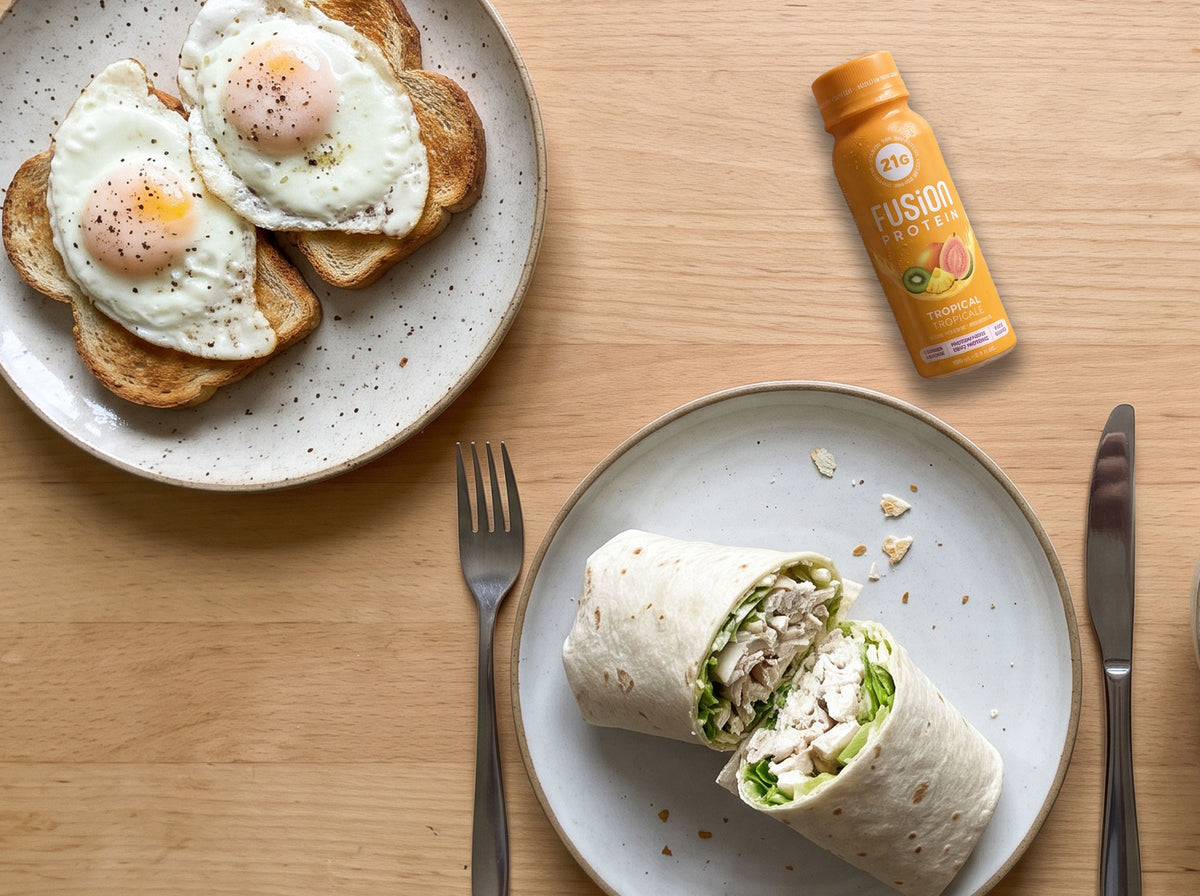
Hitting 25 to 30 grams of protein in the morning does not mean you have to fry up five eggs or spend twenty minutes cooking before work. When a protein shot or shake does the heavy lifting (20 to 21 grams), everyday breakfast staples easily carry you across the finish line while adding the fibre, carbs, and fat that keep your stomach quiet until lunch.
Here are five no-cook (or two-minute) breakfast combinations:
| Breakfast Combo | Protein Source | Whole-Food Pairing | Total Protein | Fibre |
|---|---|---|---|---|
| 🍞 Toast & PB | 1 Fusion shot (21 g) | 2 slices whole-wheat toast (7.8 g) + 1 tbsp natural peanut butter (3.7 g) | 32.5 g | 5.9 g |
| 🥣 Oats & Berries | 1 Fusion shot (21 g) | 3/4 cup cooked oatmeal (4.9 g) + 1 tbsp hemp seeds (3.3 g) + 1/2 cup raspberries (0.8 g) | 30.0 g | 8.2 g |
| 🫐 Yogurt Bowl | 1 Fusion shot (21 g) | 1/2 cup plain 2% Greek yogurt (12.3 g) + 1/4 cup chopped walnuts (4.6 g) + 1/2 cup blueberries (0.6 g) | 38.5 g | 5.3 g |
| 🥚 Eggs & Toast | 1 Fusion shot (21 g) | 1 large hard-boiled egg (5.9 g) + 1 slice whole-wheat toast (3.9 g) + 1 medium apple (0.5 g) | 31.3 g | 5.8 g |
| 🥤 Blender Smoothie | 1 scoop whey powder (20 g) | 1 cup 2% milk (8.5 g) + 1/3 cup dry rolled oats (4.0 g) + 1 tbsp chia seeds (1.8 g) | 34.3 g | 6.5 g |
Food values from Health Canada's Canadian Nutrient File. Protein shot values from the Fusion label; whey values vary by brand.
Protein shake for breakfast and weight loss
When people swap their morning meal for a protein shake to manage their weight, they often fall into the "100-calorie trap." They replace a 450-calorie breakfast with a 110-calorie shake mixed with water, thinking they just banked a massive calorie savings for the day.
In practice, cutting breakfast down to bare-bones liquid protein often backfires. By 10:30 a.m., hunger sets in hard, and the office muffin, mid-morning pastry, or heavy afternoon snacking ends up adding more calories than a proper breakfast would have in the first place.
Research shows that a higher-protein morning meal can help support appetite control, provided it is part of an actual meal with enough calories to hold you:
- In the 2013 study by Heather Leidy and colleagues (American Journal of Clinical Nutrition), the 20 overweight or obese young women (ages 18 to 20) did not drink a low-calorie shake. Their high-protein breakfast was a 350-calorie solid meal with 35 grams of protein, built around eggs and beef. It led to more fullness than the normal-protein (13 g) breakfast, and it was the only one of the two that cut evening snacking on high-fat foods compared with skipping breakfast (note: funded by the Beef Checkoff program and the Egg Nutrition Center).
- Simply adding extra protein to breakfast does not automatically guarantee changes on the scale by itself. In Leidy's later 2015 randomized controlled trial published in Obesity, 57 adolescents who habitually skipped breakfast were assigned to eat either a normal-protein breakfast (13 g) or a high-protein breakfast (35 g) for 12 weeks, or continue skipping. When researchers directly compared the high-protein group against the normal-protein group, no differences were detected in weight, body composition, or other outcomes.
The bottom line
A plain protein shake on its own is not enough for breakfast. While it gives you a quick 20+ grams of protein, it lacks the dietary fibre, complex carbohydrates, and healthy fats that slow down digestion and keep your stomach full until noon.
To turn your morning protein into a complete breakfast, aim for 25 to 30 grams of total protein and pair it with whole foods that provide at least 5 grams of fibre and a bit of fat. You can blend oats, berries, and nut butter right into a smoothie, or skip the blender entirely by drinking a quick protein shot alongside everyday staples like whole-grain toast, oatmeal, or fruit. If you want a deeper look at how compact liquid protein fits into a balanced diet, check out our guide on whether protein shots are good for you.
Frequently asked questions
Is it okay to only drink a protein shake for breakfast?
Can I have a protein shake for breakfast every day?
Can I drink a protein shake on an empty stomach in the morning?
Can I drink a protein shake for breakfast if I don't work out?
Is it okay to drink a protein shake while eating breakfast?
Are 2 eggs enough protein for breakfast?
The protein part of breakfast, done.
21 grams of protein in 90 calories, ready to drink in two seconds flat. Pair it with the breakfast you already eat.
Shop Fusion Protein →Our Guides
